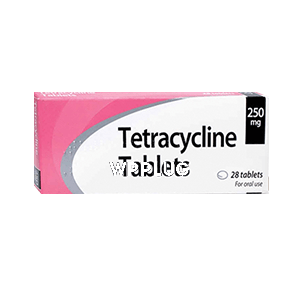
| Product dosage: 250mg | |||
|---|---|---|---|
| Package (num) | Per pill | Price | Buy |
| 180 | $0.32 | $57.07 (0%) | 🛒 Add to cart |
| 360 | $0.29
Best per pill | $114.13 $104.12 (9%) | 🛒 Add to cart |
| Product dosage: 500mg | |||
|---|---|---|---|
| Package (num) | Per pill | Price | Buy |
| 60 | $0.72 | $43.05 (0%) | 🛒 Add to cart |
| 90 | $0.63 | $64.57 $57.07 (12%) | 🛒 Add to cart |
| 120 | $0.58 | $86.10 $70.08 (19%) | 🛒 Add to cart |
| 180 | $0.55 | $129.15 $98.11 (24%) | 🛒 Add to cart |
| 270 | $0.52 | $193.72 $139.16 (28%) | 🛒 Add to cart |
| 360 | $0.51
Best per pill | $258.30 $182.21 (29%) | 🛒 Add to cart |
Similar products
More info:
Tetracycline: Effective Bacterial Infection Treatment - Evidence-Based Review
Tetracycline is a foundational broad-spectrum antibiotic in the tetracycline class, originally derived from Streptomyces bacteria but now largely produced synthetically. It functions by inhibiting bacterial protein synthesis, binding reversibly to the 30S ribosomal subunit, which prevents aminoacyl-tRNA from attaching to the mRNA-ribosome complex. This monograph will detail its formulation, mechanisms, clinical applications, and practical considerations based on current evidence and extensive clinical experience. 1. Introduction: What is Tetracycline? Its Role in Modern Medicine Tetracycline represents one of the early discoveries in antibiotic therapy that revolutionized infectious disease treatment.
Accutane: Definitive Treatment for Severe Acne - Evidence-Based Review
Isotretinoin, commonly known by its former brand name Accutane, remains one of the most clinically significant and controversial medications in dermatology. This oral retinoid represents the nuclear option for severe, recalcitrant nodular acne that has defied all other conventional therapies. I remember my first encounter with isotretinoin wasn’t in a textbook; it was during my residency, watching a senior consultant manage a 19-year-old patient named Sarah whose cystic acne had left her socially isolated.
azipro
Azipro represents one of those rare convergence points where pharmaceutical precision meets nutritional science. We’re looking at a high-potency zinc ionophore system combined with targeted transport molecules that fundamentally changes how we approach intracellular zinc delivery. The development team actually fought for eighteen months about whether to classify it as a medical device or dietary supplement - the mechanism is so specific it blurs traditional categories. What’s fascinating is how it emerged from oncology research.
Ceftin: Broad-Spectrum Antibiotic Therapy for Bacterial Infections - Evidence-Based Review
Cefuroxime axetil, marketed under the brand name Ceftin, represents a critical second-generation cephalosporin antibiotic available in both oral tablet and suspension formulations. Its development in the 1980s addressed a significant gap in outpatient management of moderate bacterial infections, particularly those involving beta-lactamase producing organisms that rendered earlier penicillins ineffective. The prodrug design of cefuroxime axetil enhances oral bioavailability, making systemic cephalosporin therapy feasible outside hospital settings. For healthcare providers, Ceftin remains a workhorse antibiotic for respiratory, skin, and urinary tract infections, especially when penicillin allergies or resistance patterns dictate alternative therapy.
Cenmox: Effective Bacterial Infection Treatment - Evidence-Based Review
Cefuroxime axetil, commonly known by its trade name Cenmox, represents a second-generation cephalosporin antibiotic with a well-established position in antimicrobial therapy. What makes this particular formulation clinically interesting isn’t just its broad-spectrum coverage, but the clever prodrug design that significantly enhances its oral bioavailability compared to earlier cephalosporins. We’ve been using this agent in various clinical settings for decades now, and its utility persists despite the emergence of newer antibiotics.
Chloramphenicol: Potent Antimicrobial Therapy for Resistant Infections - Evidence-Based Review
Chloramphenicol remains one of those fascinating antibiotics that every infectious disease specialist has a complicated relationship with. I remember pulling it for a meningitis case during my residency - the pharmacy director actually came down to verify the order personally. That’s how significant this drug is. It’s a broad-spectrum bacteriostatic antibiotic originally isolated from Streptomyces venezuelae back in 1947, though most formulations today are synthetic. What makes chloramphenicol so clinically valuable, and simultaneously concerning, is its exceptional ability to penetrate tissues where other antibiotics struggle - the central nervous system, the eye, intracellular spaces.
chloromycetin
Chloramphenicol, marketed historically as Chloromycetin, remains one of the most fascinating and clinically challenging antibiotics in our arsenal. I remember first encountering it during my infectious disease rotation in the late 90s – this peculiar gray capsule that could save a meningitis patient but carried that ominous black box warning. It’s not something we reach for lightly, but when you need it, nothing else quite compares. ## 1. Introduction: What is Chloromycetin?
dapsone
Dapsone, a sulfone antimicrobial agent, has been fascinating to work with over my 25 years in dermatology and infectious disease. I remember first encountering it during residency when we had a leprosy patient transferred from an endemic region - back then we still called it DDS (diaminodiphenyl sulfone), and the pharmacy had to specially compound it. What started as a niche antimycobacterial has evolved into one of our most versatile weapons against inflammatory dermatoses.
doxycycline
Doxycycline is a broad-spectrum tetracycline-class antibiotic derived from oxytetracycline. It’s one of those workhorse medications that every clinician ends up reaching for regularly, but its true depth often gets overlooked in the rush of daily practice. What makes doxycycline particularly valuable isn’t just its antimicrobial coverage but its unique pharmacokinetic profile that allows for convenient dosing and generally good tolerability compared to earlier tetracyclines. I’ve been prescribing this agent for over fifteen years across various clinical settings, from busy urban emergency departments to remote tropical medicine clinics, and I’m still discovering new nuances about its applications.